In a town that is spread over the tops and slopes of several hills, with quiet streets draped in bougainvillea and houses painted only in whitewash, is where a most cherished food-memory was born. My son, Joe, and I were in Ostuni, Italy, known as La Citta Bianca (the white city), with Global Volunteers to teach conversational English to the locals.
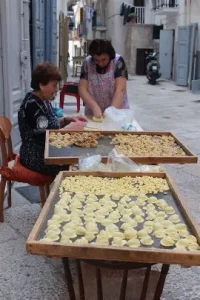
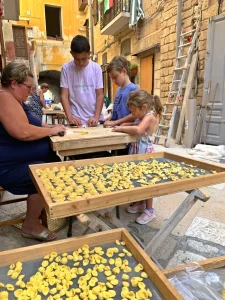
In the backstreets of Bari Vecchia, the old quarter of Puglia’s sun-washed capital, women sit at wooden tables, shaping pasta with the rhythmic press of their thumbs. Each orecchietta — “little ear” — is handmade with love. The air smells faintly of semolina and sea breeze, and conversation flows as easily as wine. This is no culinary performance for tourists. It’s a tradition — one rooted in centuries of history, passed from mother to daughter, shaped not by machines but by memory.
Puglia, the heel of Italy’s boot, is a land of ancient olive trees, wind-swept plains, and sun-kissed fields of wheat. It is here, in this stark and stunning landscape, that orecchiette was born — a pasta perfectly suited to its environment and people.
At the heart of orecchiette lies a tactile tradition. The dough is kneaded until elastic, then rolled into slender ropes. From these, small discs are sliced and pressed with the thumb or the side of a knife, then gently flipped inside out. The result is a small, cupped shape with a ridged exterior and a tender interior — ideal for capturing sauce.
Unlike many pastas shaped by bronze dies or industrial molds, orecchiette remains fiercely handmade in Puglia, especially among the older generation. The technique is meditative, almost musical — a repetitive gesture that becomes second nature over time. Some compare this pasta process to rosary prayer, both thought of as a woman’s work … both sacred.
The pasta dries on wooden boards or mesh trays, sometimes outside under the Apulian sun. It’s a ritual of both nourishment and pride, anchoring families and neighborhoods with every batch.

In an era of mass-produced pasta and globalized food culture, orecchiette stands as a quiet rebellion. Its survival is not nostalgic — it’s practical, sustainable, and deeply communal.
Ingredients:
- 1 large yellow onion, peeled
- 6 tablespoons extra-virgin olive oil, divided (Medium)
- 2 large garlic cloves, minced
- 1 bunch Swiss chard or rapini
- 8 ounces orecchiette pasta
- Salt and black pepper
- 1/2 cup Parmigiano-Reggiano, grated
- Cut the onion in half and then into thin slices.
- In a sauté pan, large enough to hold the cooked pasta, cook the onion in 2 tablespoons of the oil for 10 minutes. The onions should be tender and translucent. Season with 1/2 teaspoon of salt and a few grinds of black pepper.
- Add the garlic and cook for 2 minutes, stirring so the garlic doesn’t brown and then transfer to another dish.
- To cut the chard, stack several of the leaves, one on top of the other and then slice them crosswise into ribbons. Repeat until you’ve cut the entire bunch. I prefer to wash leafy greens, such as chard and kale, after I cut them because I feel that they get a more thorough cleaning. Place the cut chard into a large bowl with cool water and using your hands, swish them around. Scoop out the greens into a colander and rinse again. Unless you have a very large bowl and colander to carry out this task, which I do not, do this in batches. Let the greens drain.
- Heat 2 tablespoons of the olive oil and add half of the chard then sauté until wilted and soft, about 5 minutes. Season with 1/2 teaspoon salt and fresh ground black pepper. Transfer the greens to the dish with the onions and garlic.
- Add the last 2 tablespoons of olive oil to the pan and cook the remainder of the chard. Season with 1/4 teaspoon salt and a few grinds of black pepper. Now, add the onions and cooked chard to the pan. Mix in the cheese and then turn off the heat and set pan aside.
- Meanwhile, in a large pot of salted water, cook the orecchiette. Before you drain the pasta, reserve some of the pasta water. Add the pasta to the pan and then stir in 2 tablespoons of the pasta water.
- To serve, transfer to a large platter or individual pasta bowls. Mangia bene!