

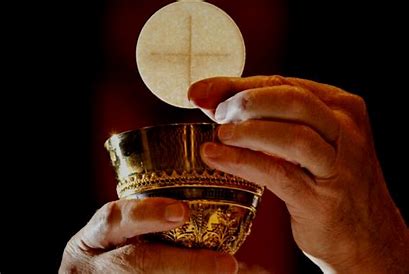
“At the Last Supper, Jesus knew he was about to die. He knew he would not be able to eat Passover again. Fully aware of this, he invited his disciples to a Last Supper of a very special kind. During the meal, he gave them something new: he gave them himself as the true Lamb and thereby instituted his Passover.” Pope Benedict XVI
While they were eating, Jesus took bread, said the blessing, broke it, and giving it to his disciples said, ‘Take and eat; this is my body.’” – Matthew 26:26
At the last supper, Jesus instructs us to remember him in celebration of the Eucharist. Christ enables us to live in him all that he himself lived, and he lives it in us. “By his Incarnation, he, the Son of God, has in a certain way united himself with each man.” (Pope John Paul II). We are called only to become one with him, for he enables us as the members of his Body to share in what he lived for us in his flesh as our model:
For in one Spirit we were all baptized into one body, whether Jews or Greeks, slaves or free persons, and we were all given to drink of one Spirit.
If (one) part suffers, all the parts suffer with it; if one part is honored, all the parts share its joy (1 Corinthians: 12:13).
This passage emphasizes the unity and interconnectedness of all believers, regardless of their background or status. It highlights how the well-being of one member affects the entire community.
A Holy Sacrifice
The Mass is a unique and marvelous sacrifice. It is the mystical reality in which Christ’s sacrifice on the cross is renewed. The Mass is also a sacred banquet where together as the Church family, we fulfill Jesus’ command at the Last Supper to “Do this in memory of me.”
The Eucharist is the sacramental celebration of the Paschal Mystery – the crucifixion, death, and resurrection of Jesus Christ. The Greek word eucharistein means “to give thanks.” At every Mass, we give thanks for Christ’s one and abiding sacrifice for the life of the world.
The Eucharist makes present the saving death and resurrection of Christ. We are invited to unite our sufferings, wounds, and trials to Christ in the Liturgy of the Eucharist. As Saint Paul tells us, we are called to imitate what we worship – Christ – and offer ourselves as “a living sacrifice” (Rom 12:1). This is exactly what should happen at Mass.
A Holy Meal
Active participation in the liturgy is central to our Catholic faith. It is here that we are formed in the Christian life.
“In the Eucharist,” says Pope Benedict the XVI, “the faith of the Church is proclaimed, celebrated and strengthened. All of the faithful are invited to participate in the Eucharist actively, fruitfully and with awareness, in order to be authentic witnesses of the Lord.”
We believe that the risen Christ is really and truly present in four ways in the liturgy. In the holy Eucharist, we experience his real presence – body, blood, soul, and divinity. Christ is also present, albeit in a different way, in the presider, in the Word as read from the sacred Scriptures, and in the community gathered together.
Today’s liturgy stresses the importance of gathering all believers around the table of the Lord to be nourished by Christ himself. We participate in the Eucharistic sacrifice with reverence and prayer and “each has his own part to play in the liturgical action.” As we receive holy Communion, we are transformed into the living body of Christ in the world.
At the end of every Mass, we are challenged to go forth and bring Christ to others through our words and actions. This is evangelization. Every Mass offers the challenge to go be Christ for one another. This is exactly what St. John Chrysostom taught in his homilies about the link between Mass and our behavior.
“Of what use is it to weigh down Christ’s table with golden cups, when he himself is dying of hunger? What if you were to see Jesus clad in rags and stiff from the cold, and were to forget clothing him and were to set up golden columns for him, saying you were honoring him? Let us learn, therefore, to be people of wisdom and honor Christ as he desires.”
After we receive Communion, the church is quiet. We are called to listen to Jesus in our hearts and minds. The sacrament of the holy Eucharist is transformative. An encounter with the person of Jesus Christ is meant to change us, renew our spirit, and deepen our faith.
“Behold what you are. Become whom you receive.”
—St. Augustine


