

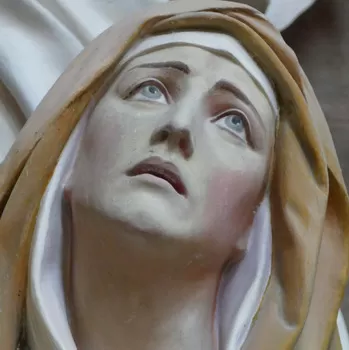
Mary was bestowed the title of ‘Our Lady of Sorrows’ to fully recognize the challenges and pain that she felt throughout her life. Her challenges were prophesied by Simeon, who said that Mary’s soul would be pierced with a sword. Tradition recognizes seven special situations in the life of Christ where Mary suffered great sorrow. These are known as the Seven Sorrows of Mary and the subject of many reflections in grief and sorrow. She went on to accompany Jesus on the road to Calvary and then saw His Death on the Cross.
Early Church writers, such as Saint Ambrose, viewed Mary as a resolute and sorrowful presence at the Crucifixion. Amidst the flight of others, Mary fearlessly stood by the cross, gazing upon her Son’s wounds with compassion and recognizing their role in humanity’s salvation. Mary’s unwavering stance and self-offering in the face of persecution depict her as a powerful yet sorrowful figure.
Our Lady of Sorrows is represented with seven daggers piercing her heart, each representing one of the Seven Sorrows.
“While other martyrs suffered by sacrificing their own lives, the Blessed
Virgin suffered by sacrificing Her Son’s life – a life that She loved far more than Her own; so that She not only suffered in Her soul all that Her Son endured in His body, but moreover the sight of Her Son’s torments brought more grief to Her heart than if She had endured them all in Her own person.” — St. Antoninus
“The martyrs endured their torments in their bodies; Mary suffered Hers
in Her soul.” … St. Alphonsus de Liguori. “Now, as the soul is more noble
than the body, so much greater were Mary’s sufferings than those of all the
martyrs, as Jesus Christ Himself said to St. Catherine of Siena: ‘Between the
sufferings of the soul and those of the body there is no comparison.’”
Devotion to the Mother of Sorrows dates back to the beginning of the
Church. The first example we have is St. John at the foot of the Cross. This
devotion was ensured in Church history by the gospel narrative of St. John —
“Now there stood by the Cross of Jesus, His Mother …” (John. 19:25).
Though the devotion has always been part of Catholic piety, it was not
until the 13th Century that the devotion of meditating on the sorrows of
Our Lady began to flourish much more.
Our Lady’s Sorrows are commemorated twice a year on the liturgical
calendar, September 15, and the Friday before Palm Sunday. Commemorating
the Sorrows of the Blessed Virgin Mary twice a year on the Roman Liturgical
Calendar demonstrates how important this devotion is to Heaven.
Sunday, September 15th, the Feast of Our Lady of Sorrows, serves as a poignant reminder of Mary’s role in the redemptive narrative and her deep empathy for her Son’s suffering.
Beginning on September 6th and culminating on her feast day, praying the Our Lady of Sorrows Novena provides an opportunity to unite our own sufferings with those of Mary and to seek her intercession for the grace to endure life’s trials with faith and courage.
Like all feast days, this feast gives glory to God for the salvific work that He accomplished in one of His creatures, in this case His greatest creaturely work, Mary. For Mary herself, her earthly maternal union of heart and soul with Her Son, in which she experienced both joys and sorrows, is now perfectly consummated in Heaven. However, her maternal love and union extends to us still here on Earth!


