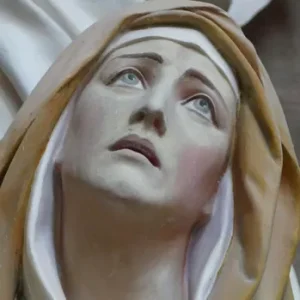
We tend to think of Mary as the Sorrowful Mother during Lent. We know from Scripture that she was there, standing at the foot of the Cross with the Apostle John. She’s mentioned twice when we pray the Stations of the Cross — in the Fourth Station, when she meets her Son on the way to Golgotha and in the Thirteenth Station when Jesus’ dead body in placed in her arms.
In that respect, it’s fitting that the Memorial of Our Lady of Sorrows take place the day after the Feast of the Exaltation of the Holy Cross, observed annually on September 14. On that day, we celebrate the finding of the True Cross by St. Helena in the fourth century and its veneration throughout the centuries since. On the Memorial of Our Lady of Sorrows, we venerate the Mother of the Crucified One in appreciation of the terrible grief she endured as her Son suffered. But that’s not the only sorrow Mary endured, and it’s not the only one we honor on this feast day. There are seven. These seven sorrows were foretold by Simeon in the Temple when he encountered the Holy Family at the Presentation of Jesus:
First Sorrow: The Prophecy of Simeon
“Now there was a man in Jerusalem, whose name was Simeon, and this man was righteous and devout, looking for the consolation of Israel, and the Holy Spirit was upon him. And it had been revealed to him by the Holy Spirit that he should not see death before he had seen the Lord’s Christ. … Simeon blessed them and said to Mary his mother, ‘Behold, this child is set for the fall and rising of many in Israel, and for a sign that is spoken against (and a sword will pierce through your own soul also), that thoughts out of many hearts may be revealed.’”– Luke 2:25–26, 34–35
Second Sorrow: The Flight into Egypt
“An angel of the Lord appeared to Joseph in a dream and said, ‘Rise, take the
child and his mother, and flee to Egypt, and remain there till I tell you, for Herod is about to search for the child, to destroy him.’ And he rose and took the child and his mother by night, and departed to Egypt, and remained there until the death of Herod.”– Matthew 2:13–15
Third Sorrow: Loss of the Child Jesus for Three Days
“Now his parents went to Jerusalem every year at the feast of the Passover. And when he was twelve years old, they went up according to custom; and when the feast was ended, as they were returning, the boy Jesus stayed behind in Jerusalem. His parents did not know it. … After three days they found him in the temple, sitting among the teachers, listening to them and asking them questions; and all who heard him were amazed at his understanding and his answers. And when they saw him they were astonished; and his mother said to him, ‘Son, why have
you treated us so? Behold, your father and I have been looking for you anxiously.’”– Luke 2:41–43, 46–48
Fourth Sorrow: Mary Meets Jesus on His Way to Calvary
“And as they led him away, they seized one Simon of Cyrene, who was coming in from the country, and laid on him the cross, to carry it behind Jesus. And there followed him a great multitude of the people, and of women who bewailed and lamented him.”– Luke 23:26–2
Fifth Sorrow: The Crucifixion and Death of Jesus
“Standing by the cross of Jesus were his mother, and his mother’s sister, Mary
the wife of Clopas, and Mary Magdalene. When Jesus saw his mother, and the
disciple whom he loved standing near, he said to his mother, ‘Woman, behold your son!’ Then he said to the disciple, ‘Behold, your mother!’”
– John 19:25–2
Sixth Sorrow: The Body of Jesus Taken from the Cross
“Since it was the day of Preparation, in order to prevent the bodies from remaining on the cross on the sabbath (for that sabbath was a high day), the Jews asked Pilate that their legs might be broken, and that they might be taken away. So, the soldiers came and broke the legs of the first, and of the other who had been crucified with him; but when they came to Jesus and saw that he was already dead, they did not break his legs. But one of the soldiers pierced his side with a spear, and at once there came out blood and water.”– John 19:31–3
Seventh Sorrow: The Burial of Jesus
“Joseph of Arimathea, a respected member of the council, who was also himself looking for the kingdom of God, took courage and went to Pilate, and asked for the body of Jesus. … And (Joseph of Arimathea) bought a linen shroud, and taking him down, wrapped him in the linen shroud, and laid him in a tomb which had been hewn out of the rock; and he rolled a stone against the door of the tomb.”– Mark 15:43, 4
This is a lot for one woman to endure in a lifetime! Yet, Mary wasn’t just another woman; she was the woman chosen by God to bear his Son. With that great joy and responsibility also came great sorrow.
Along with her great joy and sorrow came great love — for each one of us as her children. This is what our Lord asked of her as he hung dying on the Cross — to become Mother to all humankind. Love is what gave her the courage to accept Simeon’s prophecy. Love is what gave her the strength to embrace each sword as it pierced her heart. Love is what urged here to accept her Son’s dying request. Love is what compels her to continue caring for us tenderly, limitlessly, and faithfully.
We pray: Our Lady of Sorrows, our hearts ache for you and the pains that you suffered in your life. We know that these Sorrows helped you to understand and care for all of us. As we face fears, pains, and temptations, we ask that you place our loved ones and us under the protection of your mantle. As our mother, show us how to love your Son even more. Help us to better understand His Passion and Death. Guide us to His Sacred Heart. Amen.
“So great a love has our Heavenly Mother for us, that She deserves our gratitude, and that gratitude should be shown by at least meditating upon,and pitying Her in Her Sorrows.” … St. Alphonsus de Liguori.